


Improving Oil Yield in Tire Pyrolysis
Pyrolysis oil is one of the principal value streams in a tire pyrolysis project. Increasing oil yield can improve overall plant economics, but simply raising the reactor temperature is rarely an effective optimization strategy.
Waste tire is a complex composite containing natural rubber, synthetic rubber, carbon black, steel, additives, and reinforcing materials. During thermal conversion, these components undergo different decomposition pathways and produce oil, non-condensable gas, and solid residue.
Oil yield is therefore determined by the interaction between feedstock composition, particle size, heating rate, reaction temperature, vapor residence time, condensation efficiency, and process stability.
A practical optimization strategy should focus on the entire conversion and recovery chain rather than pursuing a single operating parameter.
Feedstock Composition Establishes the Yield Ceiling
The first factor affecting oil production is the composition of the incoming tire.
Different tire formulations contain different proportions of natural rubber, styrene-butadiene rubber, butadiene rubber, carbon black, steel, and additives. Passenger tires, truck tires, and off-the-road tires can therefore exhibit different pyrolysis behavior.
A consistent feedstock stream makes process optimization considerably easier. Excessive contamination with soil, water, or foreign material can dilute the organic fraction and increase the energy required for thermal conversion.
Feedstock characterization should establish moisture, ash, rubber fraction, and other relevant properties before operating parameters are optimized.
Particle Size Influences Heat Transfer
Tire size has a direct relationship with thermal penetration.
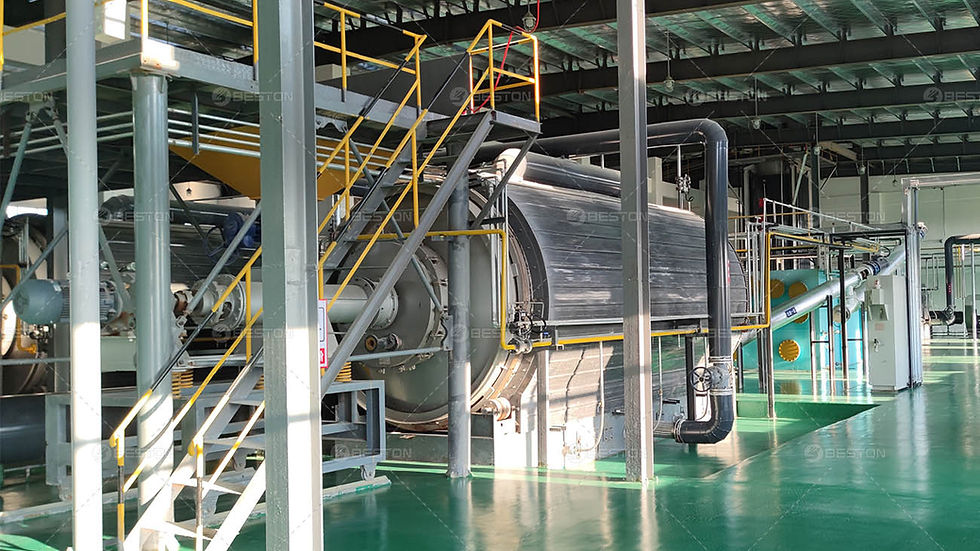
Large tire pieces can develop internal temperature gradients in tire pyrolysis reactor. The exterior may reach the desired reaction temperature while the interior remains comparatively cold. This can prolong conversion and increase the risk of inconsistent product formation.
Reducing tire size can improve heat transfer and increase the accessible surface area. However, excessive shredding also increases electricity consumption, equipment wear, and pretreatment costs.
The optimal particle size is therefore an economic compromise between thermal performance and mechanical processing requirements.
Temperature Should Be Optimized Within a Suitable Window
Temperature is one of the most influential variables affecting tire pyrolysis product distribution.
As temperature increases, the decomposition of rubber becomes more extensive. However, higher temperature does not necessarily mean higher oil yield.
At excessive temperatures, secondary cracking reactions can break larger hydrocarbon molecules into lighter gases. This can shift the product distribution away from liquid hydrocarbons and toward non-condensable gas.
A controlled temperature window can therefore favor liquid formation while limiting unnecessary secondary cracking.
Temperature uniformity is equally important. Localized overheating can alter vapor composition and create inconsistent product quality even when the average reactor temperature appears acceptable.
Heating Rate Affects Primary and Secondary Reactions
The rate at which tire material is heated influences the sequence of thermal decomposition.
Rapid heating can promote the formation of volatile products by accelerating rubber decomposition. However, the resulting vapors must leave the reaction zone efficiently. If they remain at high temperature for too long, secondary reactions can occur.
This creates an important relationship between heating rate and vapor residence time.
An optimized tyre to oil plant aims to provide sufficient heat for primary decomposition while limiting excessive secondary cracking of the resulting hydrocarbon vapor.
Vapor Residence Time Is a Critical Variable
Once hydrocarbon vapor has formed, its behavior inside the reactor and transfer system becomes increasingly important.
Long vapor residence times at elevated temperature can promote secondary cracking, polymerization, and other reactions that alter the final product distribution.
Reducing unnecessary residence time can help preserve condensable hydrocarbons and improve liquid recovery.
The design of vapor channels, transfer pipelines, separators, and condensers therefore has a direct influence on effective oil yield. Thermal insulation can also prevent uncontrolled condensation or temperature fluctuations before the vapor reaches the intended recovery stage.
Condensation Efficiency Determines Actual Oil Recovery
The amount of oil generated inside the reactor is not necessarily equal to the quantity recovered in the storage tank.
A portion of the condensable vapor can remain in the gas stream if the condensation system is inadequately designed.
Efficient condensation requires appropriate heat-transfer capacity and staged temperature control. Different hydrocarbon fractions condense at different temperatures, so a multistage configuration can improve recovery and provide greater control over the final liquid product.
Cooling-water temperature, condenser surface area, vapor flow rate, and fouling condition should all be considered when evaluating liquid recovery performance.
Process Stability Prevents Yield Fluctuation
Stable operation is often more valuable than pursuing a theoretical maximum yield.
Fluctuations in feed rate, reactor temperature, pressure, heating intensity, or gas circulation can change the thermal environment and consequently alter product distribution.
Automated feeding and temperature control can reduce these variations. Continuous monitoring also allows deviations to be identified before they develop into sustained yield losses.
Operating data should be correlated with oil output, gas production, and solid residue generation. This creates a process fingerprint that can be used to identify the operating range associated with the best overall economics.
Avoid Optimizing Oil Yield in Isolation
A higher oil yield does not automatically produce a higher project return.
Increasing liquid production may reduce gas availability for internal heating or change the properties of recovered carbon material. Additional condensation or oil upgrading equipment may also increase capital expenditure and maintenance requirements.
The appropriate target is therefore maximum economic oil recovery, not simply maximum liquid yield.
A project should evaluate oil yield alongside product quality, internal energy consumption, gas utilization, carbon black recovery, steel recovery, maintenance requirements, and operating stability.
Comments